


SPEAK UP: RESPONDING TO WORKPLACE HARASSMENT
Every Decision Has Consequences. Every Voice Has Influence. Every Employee Has a Role.
Recognizing workplace harassment is important. Knowing what to do when it happens is what makes the difference.
Most workplace harassment prevention courses explain what the law prohibits, identify inappropriate conduct, and introduce organizational reporting procedures.
But understanding the rules and applying them in real-world situations are two very different things.
What happens when you witness inappropriate conduct involving a respected colleague? How do you respond when an employee confides in you about harassment? What decisions do you make when you become the person experiencing the behavior?
And perhaps most importantly, what happens when doing the right thing creates professional consequences?
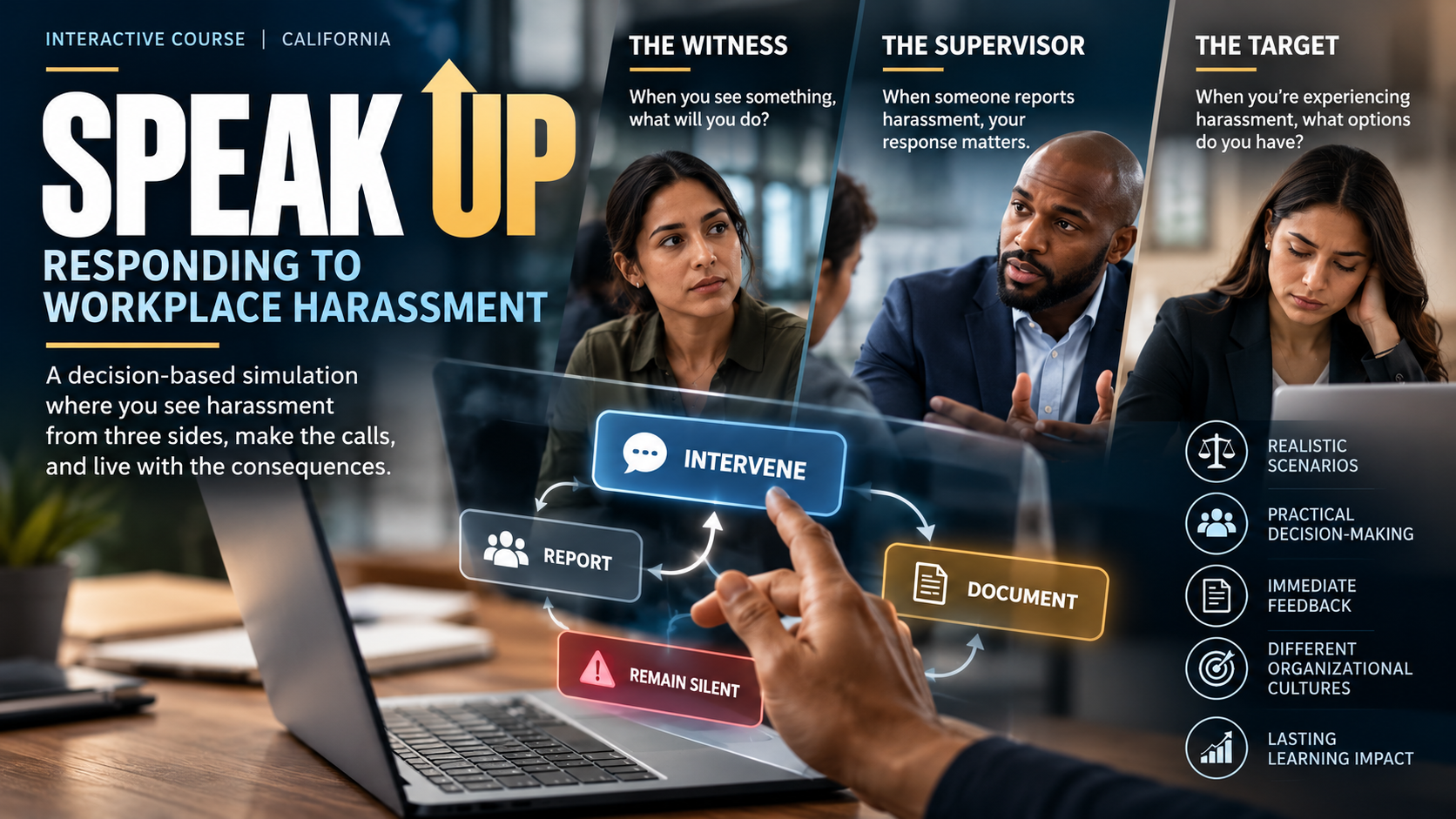
Speak Up: Responding to Workplace Harassment is an interactive, scenario-based training simulation that challenges participants to navigate the complexities of workplace harassment, reporting responsibilities, retaliation, and organizational accountability.
Rather than simply observing workplace scenarios or answering traditional multiple-choice questions, participants assume the roles of individuals directly involved in a developing workplace harassment case.
Every decision influences how the situation unfolds.
Through realistic workplace interactions, branching scenarios, and immediate feedback, participants examine how individual choices, organizational culture, leadership behavior, and reporting practices influence the prevention and resolution of workplace harassment.
The course incorporates principles associated with California's Fair Employment and Housing Act (FEHA) and federal employment discrimination law, including Title VII of the Civil Rights Act of 1964.
Three Perspectives. One Workplace. Countless Opportunities to Make a Difference.
The simulation follows a fictional workplace harassment case involving a high-performing employee whose inappropriate conduct toward a junior colleague escalates over several weeks.
Participants experience the developing situation from three distinct perspectives.
-
You observe inappropriate conduct involving a colleague.
Do you intervene? Report the behavior? Offer support? Or remain silent because you fear becoming involved?
Participants explore the responsibilities and challenges associated with witnessing workplace harassment, including the importance of appropriate intervention, reporting, and recognizing retaliation.
The simulation introduces the five approaches to bystander intervention: Direct, Distract, Delegate, Delay, and Document.
-
An employee approaches you with concerns about inappropriate workplace conduct.
How do you respond? What information should you document? What are your reporting responsibilities? How do you protect employees without compromising the integrity of the process?
Participants examine supervisory responsibilities associated with receiving complaints, communicating appropriately, initiating reporting procedures, and recognizing potential retaliation.
The simulation also challenges participants to navigate organizational pressures when the accused employee is considered valuable to the organization.
-
You become the employee experiencing inappropriate workplace conduct.
How do you respond when the behavior escalates? What information should you document? Who can you approach for assistance? What happens when reporting the conduct affects your professional relationships?
Participants explore reporting options, documentation practices, available support resources, and the challenges employees may experience when deciding whether to report harassment.
The Same Decision. Different Organizational Cultures. Different Outcomes.
One of the most important lessons in workplace harassment prevention is that organizational culture influences what happens after someone speaks up.
Throughout the simulation, participants encounter workplace environments with different levels of organizational support and accountability.
They may experience a workplace where leadership actively addresses inappropriate behavior, an organization where responses are inconsistent, or an environment where high-performing employees receive preferential treatment despite misconduct.
Participants discover that making an appropriate decision does not always produce an immediate or favorable outcome.
This dynamic encourages learners to recognize the relationship between organizational culture, employee confidence, leadership accountability, and the effectiveness of workplace reporting systems.
The simulation also tracks how decisions influence employee well-being, professional standing, team trust, organizational risk, and whether inappropriate conduct is meaningfully addressed.
By experiencing these consequences, participants develop a deeper understanding of why workplace harassment prevention requires more than policies and procedures.
It requires organizational commitment.
-
Participants will explore how to:
Recognize workplace harassment and inappropriate conduct as situations develop over time.
Apply practical bystander intervention strategies using the five Ds: Direct, Distract, Delegate, Delay, and Document.
Understand the importance of timely and appropriate reporting of workplace harassment concerns.
Identify supervisory responsibilities when receiving complaints or observing inappropriate conduct.
Recognize the limitations of confidentiality during workplace harassment investigations.
Differentiate between internal organizational reporting procedures and external reporting options.
Identify potential retaliation, including changes in assignments, performance evaluations, professional opportunities, and workplace relationships.
Understand the importance of documentation, interim protective measures, and appropriate follow-up.
Examine how organizational culture influences employee willingness to report misconduct.
Recognize how leadership decisions affect employee trust and organizational accountability.
Evaluate the potential consequences of different responses to workplace harassment.
Identify practical actions that can strengthen reporting confidence and workplace respect.
Available Learning Formats
-
The simulation can also be incorporated into instructor-led mandated workplace harassment prevention training.
Facilitated sessions may be structured for approximately 60, 90, or 120 minutes.
These sessions can incorporate group discussions, scenario analysis, collaborative exercises, and guided reflection.
This format allows participants to compare decisions, examine different perspectives, and discuss how similar situations might develop within their own organizations.
-
Participants independently complete the interactive simulation through a web browser.
Each role requires approximately 15–25 minutes.
No software installation or individual account is required.
AN INTERACTIVE LEARNING EXPERIENCE
Don't Just Learn About the Decision. Experience Its Consequences.
Speak Up is designed to encourage active participation through a branching, decision-based learning environment.
Unlike traditional training presentations, participants influence the direction of the simulation through the decisions they make.
Each role presents approximately 7–10 decisions, with different consequences and opportunities for reflection.
Participants receive feedback regarding their choices and can examine alternative responses that may produce more appropriate outcomes.
At the conclusion of the simulation, learners receive a decision-quality score, a personalized debrief, and a printable completion record.
The course encourages participants to reflect on how their decisions affect individuals, workplace relationships, and organizational responsibilities.
Available Learning Formats
California Legislative Framework
The course incorporates concepts associated with California's Fair Employment and Housing Act (FEHA) and federal Title VII employment discrimination protections.
Participants examine workplace harassment, reporting responsibilities, supervisory obligations, retaliation, and available complaint procedures.
The simulation is designed to complement workplace harassment prevention education required under California Government Code Section 12950.1.
Intended Audience
This course is designed for:
General employees seeking practical harassment prevention education.
Supervisors and managers responsible for recognizing and reporting workplace misconduct.
Human resources professionals involved in employee relations and complaint procedures.
Organizational leaders seeking to strengthen reporting confidence and workplace accountability.
Public agencies and private-sector employers interested in interactive compliance education.
Organizations seeking supplemental scenario-based learning for existing harassment prevention programs.
Organizational Value
Policies Establish Expectations. Decisions Reveal Organizational Culture.
Workplace harassment prevention requires employees to understand more than what constitutes prohibited conduct.
They must also recognize how their individual decisions influence the safety, confidence, and professional experiences of others.
Speak Up provides organizations with an opportunity to examine these responsibilities through realistic workplace scenarios without exposing employees to actual workplace misconduct.
By allowing participants to experience harassment-related situations from multiple perspectives, the simulation encourages empathy, critical thinking, and greater awareness of the consequences associated with workplace decisions.
The course supports organizational efforts to:
Strengthen employee awareness of workplace harassment and retaliation.
Encourage appropriate intervention and reporting.
Reinforce supervisory accountability.
Promote greater confidence in organizational reporting procedures.
Examine the relationship between leadership behavior and workplace culture.
Encourage meaningful conversations about professional responsibility.
Complement existing harassment prevention and employee development programs.
Most importantly, the simulation challenges participants to recognize that preventing workplace harassment is not solely the responsibility of human resources.
It is a shared responsibility influenced by the decisions employees and leaders make every day.
The Takeaway
Speaking Up Is a Decision. Responding Appropriately Is a Responsibility.
Every workplace interaction creates an opportunity to reinforce or undermine organizational expectations.
Whether someone witnesses inappropriate conduct, receives a complaint, or personally experiences harassment, their decisions can influence what happens next.
Speak Up challenges participants to move beyond recognizing workplace harassment and toward understanding the responsibilities associated with addressing it.