


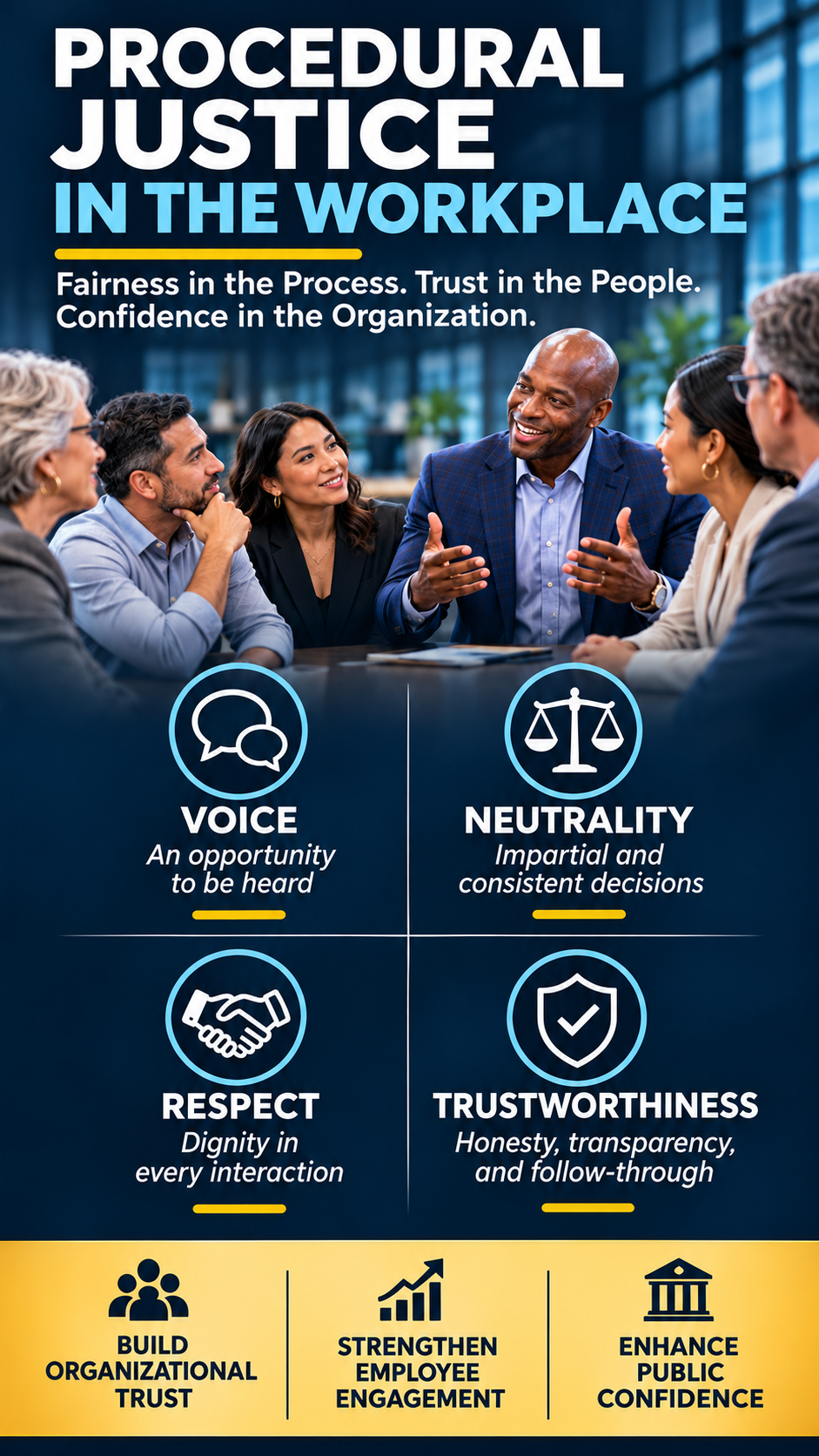
PROCEDURAL JUSTICE IN THE WORKPLACE
Fairness in the Process. Trust in the People. Confidence in the Organization.
People may not always agree with a decision. But they are more likely to respect the outcome when they believe the process was fair.
Every day, organizations make decisions that influence employees, customers, community members, and other stakeholders.
Some decisions involve hiring, promotions, performance evaluations, disciplinary actions, and workplace policies. Others involve the distribution of resources, organizational change, employee concerns, or the delivery of public services.
While leaders often focus on reaching the correct decision, an equally important consideration is how that decision is reached, communicated, and perceived by those affected.
Were individuals given an opportunity to express their perspectives? Were decisions made objectively and without favoritism? Were people treated with dignity and respect? Did those responsible for the decision demonstrate honesty, transparency, and trustworthy intentions?
These questions form the foundation of Procedural Justice.
Procedural Justice in the Workplace is an interactive professional development course designed to introduce participants to the principles of fairness, legitimacy, and organizational trust through four foundational pillars: Voice, Neutrality, Respect, and Trustworthiness.
-
Participants will explore how to:
Define the four pillars of Procedural Justice: Voice, Neutrality, Respect, and, Trustworthiness.
Explain how perceptions of fairness influence trust, legitimacy, and organizational culture.
Identify behaviors that build or diminish trust within organizations and communities.
Apply the “Community Bank Account of Trust” concept to real-world workplace and community interactions.
Describe the Five Universal Truths of Strategic Communication and their impact on stakeholder relationships.
Demonstrate practical strategies for increasing credibility, transparency, and trust during decision-making and communication processes.
Recognize the connection between Procedural Justice, employee engagement, public confidence, and organizational success.
Intended Audience
This course is designed for:
General employees seeking to strengthen professional relationships and workplace communication.
Supervisors and managers responsible for organizational decision-making.
Human resources professionals involved in employee relations, workplace investigations, and policy administration.
Executive leaders seeking to strengthen organizational credibility and employee confidence.
Public agency employees interacting with residents, businesses, and community stakeholders.
Law enforcement and public safety professionals interested in procedural justice and public trust.
Emerging leaders developing ethical decision-making and communication skills.
Organizations seeking to improve employee engagement, organizational culture, and stakeholder relationships.
The course can be customized to reflect the organization's operational environment, leadership responsibilities, stakeholder relationships, and professional development objectives.
Organizational Value
Fair Processes Strengthen Relationships. Strong Relationships Build Organizational Confidence. Every organization depends upon trust. Employees must trust that workplace decisions are made fairly. Supervisors must establish credibility with their teams. Customers and community members must have confidence that organizations will treat them with professionalism and respect. When individuals perceive organizational processes as inconsistent, biased, or dismissive, trust can deteriorate even when decisions are technically appropriate.
Procedural Justice in the Workplace helps organizations examine how decision-making practices, communication behaviors, and leadership actions influence these perceptions.
The course supports organizational efforts to:
Strengthen employee confidence in organizational decision-making.
Reinforce fairness, consistency, and transparency.
Improve communication between employees and organizational leaders.
Promote greater accountability and ethical leadership.
Reduce unnecessary conflict associated with perceptions of unfair treatment.
Encourage employee engagement and constructive participation.
Strengthen organizational legitimacy and stakeholder confidence.
Support respectful and professional workplace relationships.
Build trust between public agencies and the communities they serve.
Develop organizational cultures where fairness is demonstrated through everyday practices.
Most importantly, participants are challenged to recognize that procedural justice is not limited to executive decisions, human resources investigations, or formal organizational processes.
The Takeaway
You Cannot Demand Trust. You Must Demonstrate Why It Is Deserved. Every decision creates an opportunity to strengthen or diminish organizational credibility. Every interaction influences how individuals perceive the people and institutions around them. And every leader, supervisor, and employee has a role in demonstrating the principles that contribute to fairness and trust.
Procedural justice challenges us to recognize that organizational success is not measured solely by the outcomes we achieve.
It is also influenced by how we treat people throughout the process.