
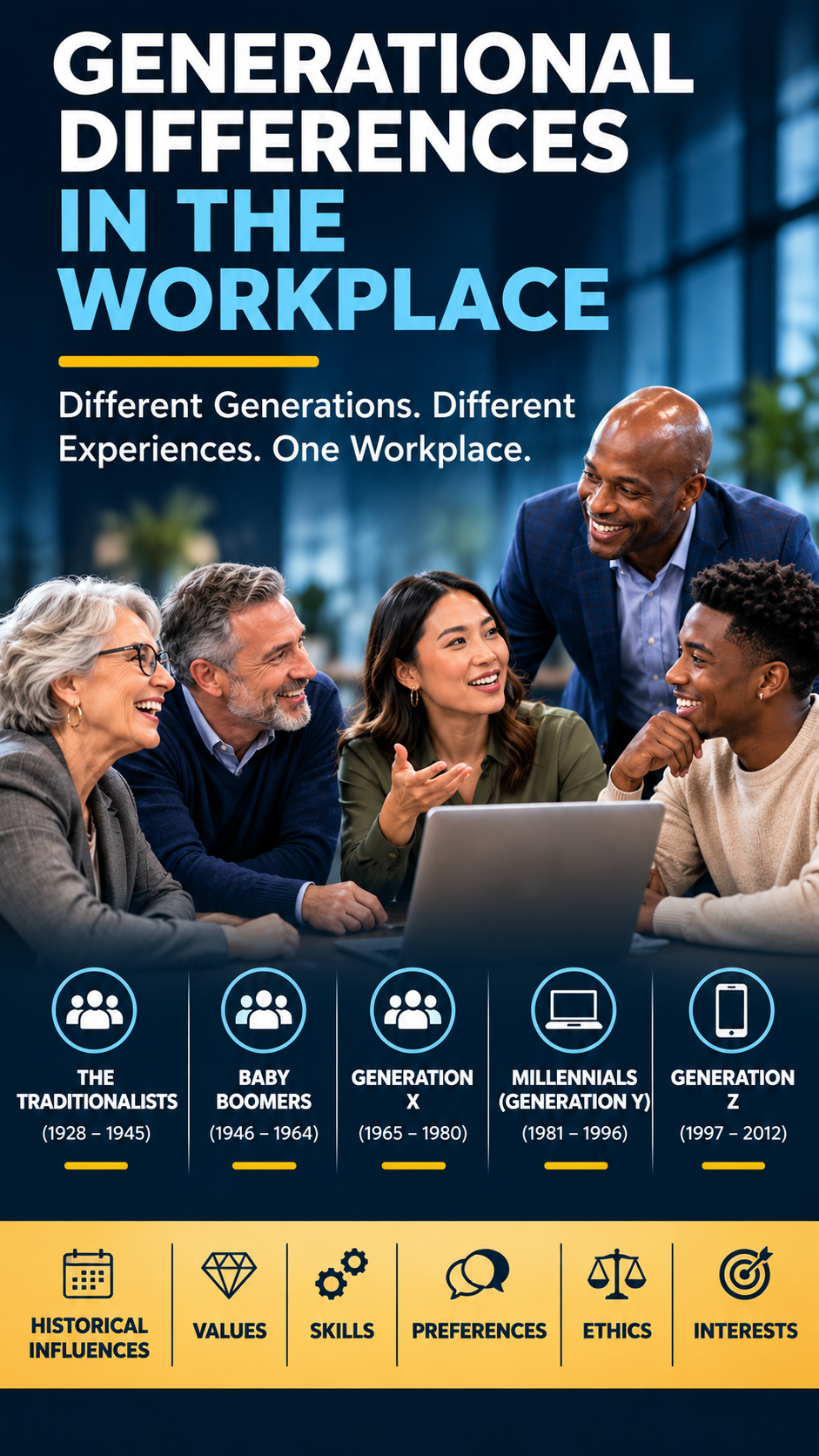
GENERATIONAL DIFFERENCES IN THE WORKPLACE
Different Generations. Different Experiences. One Workplace
We may work in the same organization, but we didn't all grow up in the same world.
Every generation enters the workplace shaped by a unique collection of historical events, societal expectations, technological advancements, economic circumstances, and cultural experiences.
Some employees remember a time when workplace communication depended on handwritten correspondence, telephone conversations, and face-to-face interactions. Others entered the workforce during the rise of personal computers, the internet, and digital communication. Today's youngest professionals are entering organizations where artificial intelligence, social media, and instantaneous access to information are increasingly commonplace.
These experiences can influence how individuals approach work, communicate with colleagues, interpret authority, define professional success, and establish expectations of their employers.
But what happens when employees from different generations must work together toward a common organizational mission?
Why might one employee value structured supervision while another prefers greater autonomy? Why do some professionals associate organizational loyalty with longevity while others emphasize professional growth and flexibility? How do different experiences influence attitudes toward technology, workplace relationships, leadership, and organizational change?
And perhaps most importantly, how can organizations leverage these differences without allowing generational assumptions to become barriers to collaboration?
Generational Differences in the Workplace is an interactive professional development course designed to introduce participants to the five generations commonly discussed in today's multigenerational workforce.
Participants examine the historical circumstances, social developments, technological innovations, and cultural influences that have shaped the environments in which these generations developed.
Through facilitated discussions, historical comparisons, collaborative exercises, and practical workplace scenarios, participants explore how generational experiences may influence professional values, skills, communication preferences, work ethics, interests, and expectations.
Rather than encouraging participants to categorize coworkers according to age, this course challenges individuals to recognize the complexity of generational identity and appreciate the diverse experiences that influence workplace behavior.
The objective is not to determine which generation is better prepared to succeed.
It is to understand how different generations can contribute to the success of the same organization.
-
Participants will explore how to:
Identify the five commonly recognized generations represented in today's workforce.
Examine significant historical events that influenced the environments in which different generations developed.
Recognize how economic, technological, political, and social changes can shape professional perspectives.
Compare commonly discussed generational differences in workplace values, interests, and expectations.
Explore how communication preferences and technological experiences may vary among employees.
Examine perspectives surrounding work ethics, organizational loyalty, professional achievement, and career development.
Recognize how different generations may approach leadership, supervision, feedback, and workplace accountability.
Identify skills and professional experiences that individuals from different generations can contribute to organizational success.
Understand how generational assumptions and stereotypes can contribute to workplace misunderstandings.
Recognize the influence of age-related biases on professional relationships and organizational decision-making.
Explore strategies for strengthening communication across generational differences.
Examine how mentoring and reverse mentoring can support organizational knowledge sharing.
Identify opportunities to improve collaboration among employees with different professional experiences.
Apply generational awareness principles to workplace communication, leadership, and team development.
Historical Perspectives: The World That Shaped Us
Participants examine significant historical events, technological innovations, and cultural developments associated with different generations.
Through guided discussions, participants consider how the same historical event may have influenced individuals differently depending on their age, circumstances, and personal experiences.
This activity encourages participants to recognize how historical context can contribute to different perspectives without assuming those perspectives are universal.
Generational Assumptions: Fact, Fiction, or Personal Experience?
Participants examine commonly expressed assumptions about different generations.
Examples may include perceptions concerning technology, workplace loyalty, communication, professional commitment, and leadership expectations.
Through facilitated discussions, participants evaluate whether these assumptions are supported by evidence, shaped by individual experiences, or influenced by stereotypes.
The objective is to challenge oversimplified conclusions and encourage greater awareness of individual differences.
Intended Audience
This course is designed for:
General employees working in multigenerational environments.
Supervisors and managers responsible for leading diverse teams.
Human resources professionals addressing employee engagement and workplace relationships.
Executive leaders seeking to strengthen organizational culture.
Emerging leaders developing interpersonal and communication skills.
Organizations experiencing workforce transitions or succession planning challenges.
Public agencies and private-sector employers seeking to improve collaboration across age groups.
The course can be customized to reflect the organization's workforce demographics, leadership structure, operational responsibilities, and professional development objectives.
Organizational Value
Different Experiences Can Become Organizational Strengths.
Every generation brings individuals with valuable knowledge, experiences, abilities, and perspectives into the workplace.
However, organizations do not automatically benefit from these differences.
Without effective communication, mutual respect, and intentional leadership, generational assumptions can contribute to misunderstandings, workplace conflict, and unnecessary divisions.
Generational Differences in the Workplace helps organizations develop greater awareness of the experiences influencing employee perspectives while challenging the stereotypes that can undermine collaboration.
The course supports organizational efforts to:
Strengthen communication among employees of different ages and professional backgrounds.
Reduce workplace misunderstandings associated with generational assumptions.
Promote mutual respect and appreciation for different experiences.
Encourage collaboration and knowledge sharing.
Support mentorship and succession planning initiatives.
Strengthen supervisory awareness of individual employee needs.
Improve approaches to professional development and employee engagement.
Promote greater adaptability during organizational and technological change.
Reinforce an organizational culture where employees are valued for their contributions rather than categorized by their age.
Most importantly, the course encourages participants to recognize that workplace culture is influenced by the relationships employees build across their differences.
An organization's strength is not determined by how many generations it employs, but by how effectively its people learn to work together.
The Takeaway: We Were Shaped by Different Times. We Share Responsibility for What Comes Next. Every generation has experienced change. Every generation has developed knowledge. Every generation has encountered challenges that influenced how its members understand the world. And every generation has something valuable to contribute.
The challenge for today's organizations is not eliminating generational differences. It is recognizing those differences, challenging assumptions, and creating opportunities for employees to learn from one another.
Because the most successful workplace isn't one where everyone thinks alike. It's one where different perspectives contribute to a shared purpose.