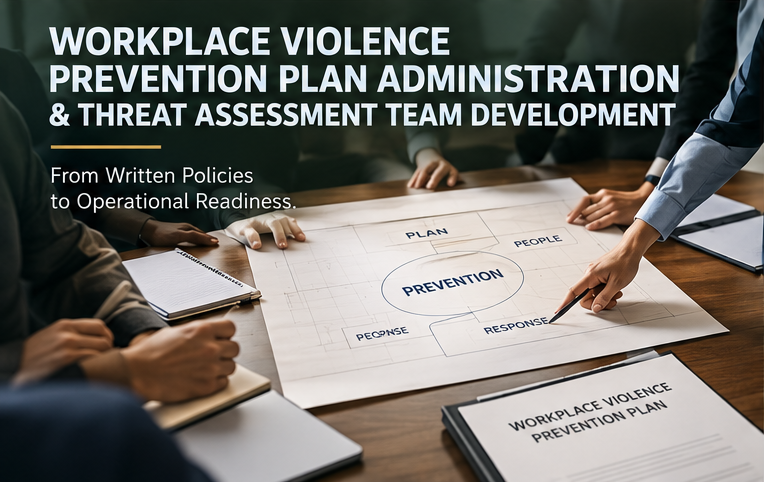


COACHING WORKPLACE VIOLENCE PREVENTION PLAN ADMINISTRATORS & THREAT ASSESSMENT TEAMS
From Written Policies to Operational Readiness.
A Workplace Violence Prevention Plan is only as effective as the people responsible for implementing it.
California's workplace violence prevention requirements have introduced significant responsibilities for employers.
However, developing a written plan is only one component of an effective prevention strategy.
Organizations must also establish procedures for identifying hazards, evaluating concerns, receiving reports, responding to incidents, maintaining records, and communicating with employees.
These responsibilities require coordination among organizational leaders, human resources professionals, safety personnel, security representatives, and other stakeholders.
Without clearly defined responsibilities and operational procedures, even a well-written plan can become difficult to implement consistently.
This specialized course is designed for Workplace Violence Prevention Plan Administrators, organizational leaders, safety personnel, and members of workplace threat assessment teams.
Participants examine the administrative, operational, and organizational responsibilities associated with developing, implementing, maintaining, and evaluating workplace violence prevention programs.
The curriculum explores the principles of behavioral threat assessment, organizational risk identification, prevention planning, and coordinated incident response.
Participants also examine how workplace violence concerns should be evaluated, documented, communicated, and addressed through appropriate organizational procedures.
Through facilitated discussions, practical exercises, and guided planning activities, participants develop a clearer understanding of how to translate workplace violence prevention requirements into actionable organizational practices.
The course emphasizes proactive prevention, cross-functional collaboration, documentation, and organizational accountability.
-
Participants will explore how to:
Understand applicable California workplace violence prevention requirements.
Identify the responsibilities of Workplace Violence Prevention Plan Administrators.
Examine considerations for establishing multidisciplinary workplace threat assessment teams.
Recognize the importance of defining team responsibilities, authority, and reporting relationships.
Understand the foundational principles of behavioral threat assessment.
Identify workplace violence hazards and organizational vulnerabilities.
Examine environmental and operational factors that may influence workplace safety.
Develop procedures for receiving, evaluating, and responding to reports of concerning behavior.
Recognize the importance of appropriate documentation and recordkeeping.
Understand the purpose and maintenance of violent incident logs.
Examine workplace violence incident reporting and investigation procedures.
Integrate prevention strategies with existing organizational policies and emergency procedures.
Identify considerations for facility design and environmental risk reduction.
Explore procedures for coordinating with law enforcement and other external resources.
Examine post-incident response, organizational recovery, and continuous improvement.
Develop strategies for maintaining employee involvement in workplace violence prevention efforts.
Practical Planning Resources
The course includes sample administrative resources that organizations may adapt to their operational needs.
Examples include:
Workplace Violence Prevention Plan templates and sample policies.
Workplace Violence Hazard Response Forms.
Workplace Violence Incident Reports.
Violent Incident Logs.
Incident Statement Forms.
Workplace Violence Prevention Administrator Rosters.
Risk Assessment Reports.
Situation Report Forms.
Sample prevention policy and procedures for administrative handbooks.
These resources are intended to support organizational planning and should be reviewed and customized before implementation.
Guided Plan Development
An important component of this course is the opportunity for participants to examine their organization's existing prevention practices.
Facilitated workgroup activities can help participants identify operational gaps, clarify responsibilities, evaluate existing procedures, and develop action items for strengthening workplace violence prevention efforts.
This approach helps connect legislative requirements with practical organizational implementation.
California Legislative Framework
This course addresses workplace violence prevention responsibilities applicable to covered general-industry employers under California Labor Code Section 6401.9.
For organizations operating in regulated healthcare environments, additional or different requirements may apply under California Code of Regulations, Title 8, Section 3342.
Training content and consulting support should be tailored to the employer's applicable regulatory framework.
Intended Audience
Workplace Violence Prevention Plan Administrators, human resources directors, risk managers, safety officers, executive leaders, facility managers, security personnel, and designated workplace threat assessment team members.
Organizational Value
An effective workplace violence prevention program requires more than regulatory awareness.
It requires clearly assigned responsibilities, coordinated decision-making, reliable documentation, and practical procedures that employees understand.
This course supports organizations seeking to strengthen their prevention infrastructure, improve operational readiness, and establish greater consistency in workplace violence risk management.
The Takeaway: Prevention is not simply having a plan. It is developing the people, systems, and organizational discipline necessary to put that plan into action.