


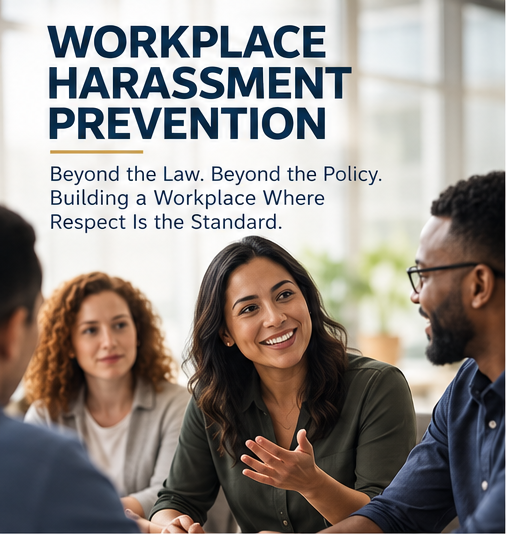
WORKPLACE HARASSMENT PREVENTION
Beyond the Law. Beyond the Policy. Building a Workplace Where Respect Is the Standard.
A workplace can have every required policy in place and still struggle with harassment, discrimination, retaliation, and inappropriate conduct.
Why?
Because policies establish expectations, but people determine whether those expectations become everyday workplace practices.
Workplace harassment prevention requires more than recognizing prohibited behaviors. It requires employees to understand their rights, supervisors to recognize their responsibilities, and organizational leaders to reinforce a culture where professional conduct, accountability, and equal opportunity are consistently demonstrated.
This interactive course examines the federal and California laws governing workplace harassment, discrimination, retaliation, and related workplace misconduct.
Participants explore the legal foundations of equal employment opportunity while examining how individual behaviors, organizational culture, supervisory decisions, and workplace communication influence the prevention and reporting of inappropriate conduct.
Through realistic scenarios, collaborative learning exercises, and facilitated discussions, participants learn to recognize conduct that may violate workplace policies or applicable laws, understand available reporting procedures, and examine their responsibilities in maintaining a professional work environment.
The curriculum addresses sexual harassment, discriminatory harassment, abusive conduct, retaliation, third-party harassment, and the responsibilities of employers and supervisors.
The course also incorporates education addressing workplace speech that vilifies, humiliates, or incites hatred against individuals based on protected characteristics, consistent with applicable California training requirements.
Rather than presenting compliance as a series of legal definitions, this course connects the law to everyday workplace interactions.
-
Participants will explore how to:
Understand federal and California laws governing workplace harassment, discrimination, and retaliation.
Recognize protected characteristics under applicable employment discrimination laws.
Differentiate between unlawful harassment, discriminatory conduct, retaliation, abusive conduct, and other inappropriate workplace behaviors.
Identify sexual harassment, including quid pro quo harassment and hostile work environment concerns.
Recognize harassment involving supervisors, coworkers, customers, contractors, and other third parties.
Examine how gossip, workplace relationships, and communication behaviors can contribute to organizational dysfunction.
Recognize workplace speech that may contribute to harassment or a hostile work environment.
Understand employee reporting options and organizational complaint procedures.
Identify supervisory responsibilities when receiving or observing potential workplace misconduct.
Examine the importance of prompt, impartial, and appropriate organizational responses to complaints.
Recognize how retaliation can occur following protected workplace activity.
Apply ethical decision-making principles to workplace conduct and leadership responsibilities.
California Legislative Framework
The curriculum is designed to address applicable training requirements and concepts arising from California Government Code Section 12950.1, including legislation such as SB 1343, AB 1825, and AB 2053, together with applicable amendments.
Training for local agency officials may also address the requirements established through AB 1661 and Government Code Section 53237.1.
The curriculum incorporates relevant education associated with AB 1803.
Available Training Formats
General Employees: A minimum of one hour of qualifying harassment prevention education.
Supervisors and Managers: A minimum of two hours of qualifying harassment prevention education.
Elected Officials, Boards, and Commissioners: Training tailored to applicable public-agency requirements.
Customized sessions can extend beyond statutory minimums to incorporate organizational policies, practical exercises, and additional professional development concepts.
Training may be available in person or through an appropriately structured virtual format.
Intended Audience
General employees, supervisors, managers, human resources professionals, executive leadership teams, public agency personnel, and local government officials.
Organizational Value
Effective harassment prevention training supports more than regulatory compliance.
It helps organizations communicate behavioral expectations, strengthen reporting awareness, reinforce supervisory accountability, and promote workplaces where employees understand their rights and responsibilities.
When employees recognize the relationship between professional conduct and organizational culture, compliance becomes more than an obligation.
It becomes part of how the organization operates.
The Takeaway: Respect is not demonstrated by the policies an organization publishes. It is demonstrated by the behaviors its people consistently practice.