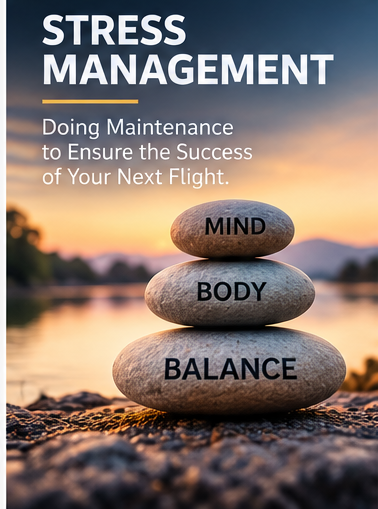


STRESS MANAGEMENT
Doing Maintenance To Ensure The Success Of Your Next Flight
You cannot continuously operate at maximum capacity without eventually considering the condition of the person responsible for the performance.
Every professional experiences stress. However, the circumstances that create stress, the way individuals interpret those circumstances, and the strategies used to manage them can differ significantly.
For some employees, stress develops from demanding workloads, competing priorities, or organizational uncertainty.
For others, it emerges from interpersonal conflict, personal expectations, unresolved experiences, or the pressure associated with leadership responsibilities.
Although stress is a common human experience, individuals do not always recognize how their thoughts, behaviors, and personal expectations influence their responses.
Drawing upon practical lessons from high-pressure professional environments, this interactive course encourages participants to examine the relationship between stress, personal perceptions, cognitive processes, and professional performance.
Participants explore how previous experiences, internal dialogue, individual values, and expectations can influence stress responses.
Rather than approaching stress management as a collection of generic relaxation techniques, the course emphasizes personal awareness, reflection, and the development of practical coping strategies.
Through guided activities, reflective exercises, and facilitated discussions, participants identify stressors, examine personal response patterns, and explore ways to strengthen their capacity to manage challenging circumstances.
The course also considers how leadership behavior, organizational expectations, and workplace relationships can influence employee stress.
-
Participants will explore how to:
Identify personal and professional sources of stress.
Recognize how previous experiences influence responses to stressful circumstances.
Examine the relationship between thoughts, perceptions, and emotional responses.
Understand the effects of stress on communication, decision-making, and performance.
Differentiate between interpersonal and intrapersonal sources of stress.
Practice reflective journaling and other self-awareness techniques.
Identify practical coping strategies appropriate for professional environments.
Examine how leadership responsibilities and organizational culture influence workplace stress.
Develop a personalized approach to managing stress and maintaining professional effectiveness.
Learning Experience
This course is designed as a highly interactive experience that encourages meaningful participation, self-reflection, and discussion.
Recommended group size: 20 participants or fewer.
The smaller learning environment supports greater engagement and allows participants to explore course concepts through structured activities.
Organizational Value
Organizations that encourage effective stress management can support employee well-being, improve professional relationships, and strengthen employees' ability to navigate demanding workplace environments.
The Takeaway: Maintaining your ability to perform tomorrow requires recognizing what you need to address today.