


ABUSIVE CONDUCT IN THE WORKPLACE
This course expands upon California Assembly Bill 2053
Not every harmful workplace behavior is unlawful harassment. That does not mean organizations should ignore it.
Workplace bullying and abusive conduct can undermine employee confidence, damage professional relationships, discourage communication, and contribute to organizational dysfunction.
These behaviors do not always involve overt threats, discriminatory statements, or conduct that clearly violates employment law.
Sometimes they appear as repeated humiliation, intimidation, professional sabotage, deliberate exclusion, or behavior designed to undermine another employee's credibility.
Other times, they become normalized within organizational culture because individuals perceive the behavior as part of a demanding workplace or an established management style.
Regardless of how these behaviors develop, failing to address them can create consequences for employees, supervisors, and the organization.
This interactive course expands upon the abusive conduct education incorporated into California's workplace harassment prevention training requirements under Assembly Bill 2053.
Participants examine the characteristics of workplace bullying, how abusive conduct develops, and the organizational conditions that may allow harmful behavior to continue.
The curriculum explores the differences between workplace conflict, legitimate performance management, abusive conduct, and unlawful harassment.
Through realistic workplace scenarios, guided discussions, and practical exercises, participants learn to identify concerning behaviors, understand reporting responsibilities, and evaluate organizational responses.
Special emphasis is placed on the responsibilities of supervisors and managers, including the importance of addressing inappropriate conduct before it becomes embedded within organizational culture.
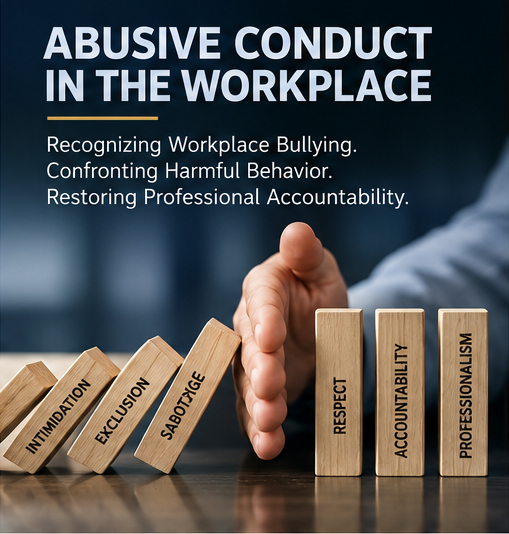
-
Participants will explore how to:
Define abusive conduct and recognize common forms of workplace bullying.
Understand California Assembly Bill 2053 and its relationship to harassment prevention education.
Differentiate between abusive conduct, unlawful harassment, workplace conflict, and legitimate supervisory responsibilities.
Identify verbal, nonverbal, psychological, and organizational forms of bullying.
Recognize how repeated intimidation, humiliation, and professional sabotage affect workplace relationships.
Examine common misconceptions surrounding workplace bullying.
Understand how implicit biases and organizational norms can influence perceptions of acceptable behavior.
Recognize the organizational consequences of failing to address abusive conduct.
Identify employee reporting options and supervisory responsibilities.
Examine appropriate approaches to receiving, documenting, and investigating workplace complaints.
Develop strategies for reinforcing professional behavioral standards.
Explore how organizational policies can be translated into consistent workplace practices.
Understanding the Legal Distinction
California's harassment prevention training requirements include education concerning abusive conduct.
However, abusive conduct does not automatically constitute unlawful harassment or create an independent legal claim solely because the behavior meets the statutory training definition.
This course helps participants understand that distinction while emphasizing the importance of addressing harmful conduct through appropriate organizational policies and management practices.
Intended Audience
Supervisors, managers, human resources professionals, executive leaders, employee relations personnel, and general employees.
This course is particularly valuable for organizations seeking supplemental education beyond their standard workplace harassment prevention training.
Organizational Value
Addressing abusive conduct helps organizations establish clearer behavioral expectations, strengthen employee confidence in reporting processes, and reinforce accountability at every organizational level.
This course supports employers seeking to prevent destructive workplace behaviors from becoming accepted organizational norms.
The Takeaway: A behavior does not have to violate the law before it becomes a leadership responsibility.